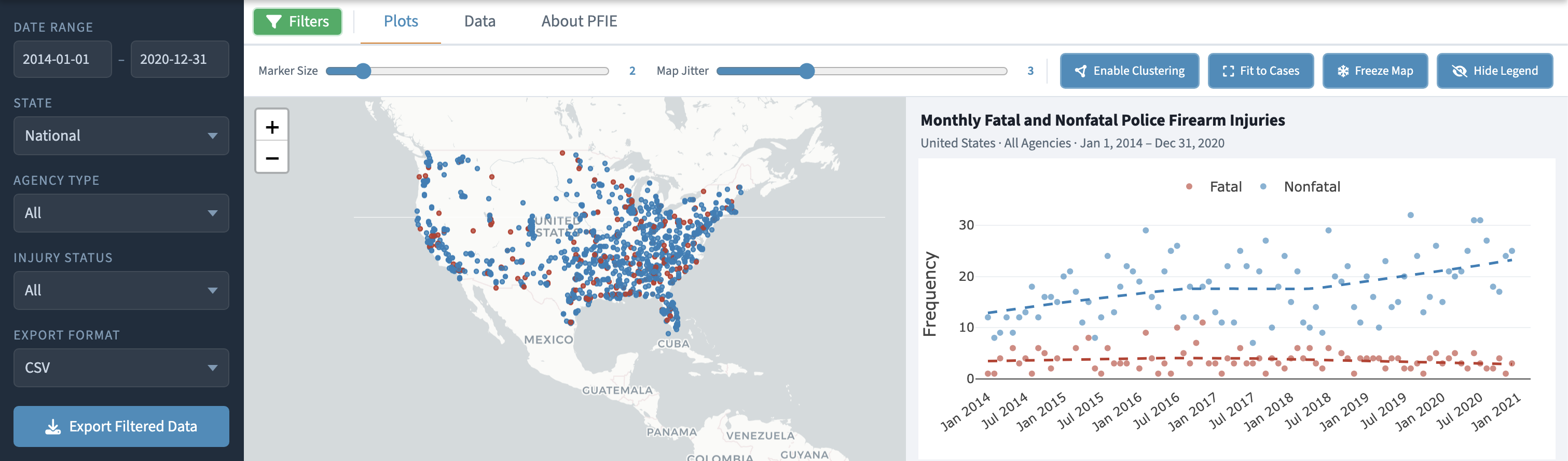
PFIE: Police Firearm Injury Explorer
Papers
Sierra-Arévalo, M., Nix, J., & Mourtgos, S. M. (2023). The 'war on cops,' retaliatory violence, and the murder of George Floyd. Criminology, 61(3), 389–420.
The police murder of George Floyd sparked nationwide protests in the summer of 2020 and revived claims that public outcry over such high-profile police killings perpetuated a violent "war on cops." Using data collected by the Gun Violence Archive (GVA) on firearm assaults of U.S. police officers, we use Bayesian structural time series (BSTS) modeling to empirically assess if and how patterns of firearm assault on police officers in the United States were influenced by the police murder of George Floyd. Our analysis finds that the murder of George Floyd was associated with a 3-week spike in firearm assaults on police, after which the trend in firearms assaults dropped to levels only slightly above that which were predicted by pre-Floyd data. We discuss potential explanations for these findings and consider their relevance to the contemporary discussion of a "war on cops," violence, and officer safety.
Sierra-Arévalo, M., Nix, J., & O'Guinn, B. (2022). A national analysis of trauma care proximity and firearm assault survival among U.S. police. Police Practice and Research, 23(3), 388–396.
Past research on factors influencing firearm assault (FA) mortality have not focused on police officers who, compared to other U.S. workers and the general public, experience especially high rates of firearm victimization. This study focuses on this unique population of FA victims and examines the relationship between travel time to the nearest trauma care facility and the probability of survival among officers shot on duty. Combining data on trauma care center location and 7 years of data on U.S. police officers fatally or non-fatally assaulted with a firearm, we use logistic regression to model the probability of FA fatality among police by proximity of the FA to the nearest trauma care facility. We find that travel time to trauma care was not associated with reduced FA mortality among police from 2014 to 2020. FA mortality was significantly lower in 2020 than the six years prior.
Sierra-Arévalo, M., & Nix, J. (2020). Gun victimization in the line of duty: Fatal and nonfatal firearm assaults on police officers in the United States, 2014–2019. Criminology & Public Policy, 19(3), 1041–1066.
Using open-source data from the Gun Violence Archive (GVA), we analyze national- and state-level trends in fatal and nonfatal firearm assaults of U.S. police officers from 2014 to 2019 (N = 1,467). Results show that (a) most firearm assaults are nonfatal, (b) there is no compelling evidence that the national rate of firearm assault on police has substantially increased during the last 6 years, and (c) there is substantial state-level variation in rates of firearm assault on police officers. GVA has decided strengths relative to existing data sources on police victimization and danger in policing. We consider the promises and pitfalls of this and other open-source data sets in policing research and recommend that recent state-level improvements in use-of-force data collection be replicated and expanded to include data on violence against police.
Data
Sierra-Arévalo, M., Nix, J., Kaplun, K., Flaherty, P. T., Villarreal, J., Pham, P. P., Bach, A., & Garcia, C. (2026). Police Firearm Injury Explorer (PFIE) [Dataset]. OSF. https://doi.org/10.17605/OSF.IO/6X2RP